I spent a half day using AI to draft a legal filing for a family friend. My final recommendation: go back and hire the lawyer.
The experiment confirmed something I had suspected. AI has absorbed a great deal of junior execution work, and in doing so it has made senior strategy and judgment more valuable, not less.
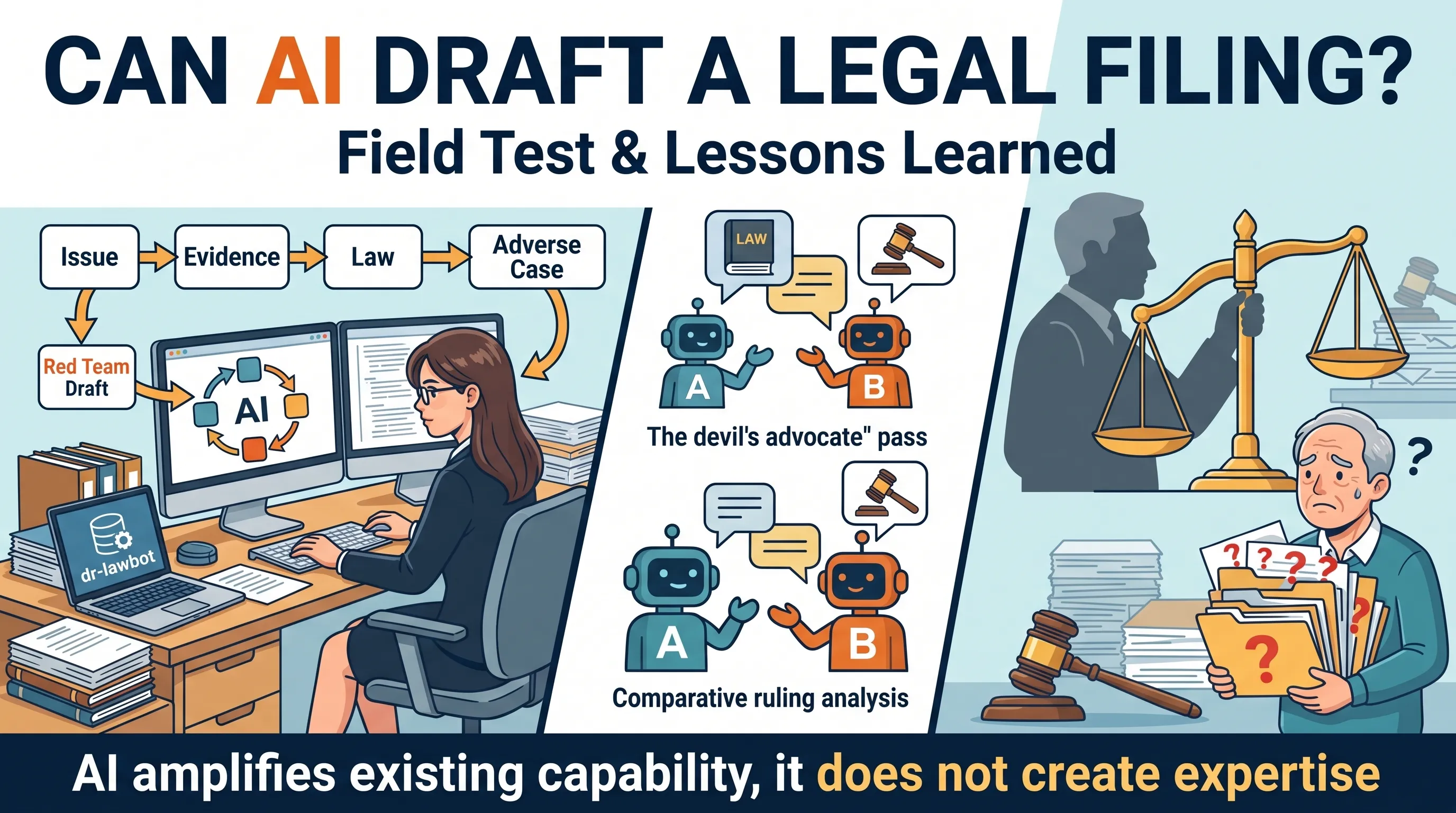
An older family friend asked me to help him produce a criminal filing with AI. Engaging a lawyer for this kind of document runs roughly NT$80,000 to NT$100,000, and his original counsel had declined, citing caseload. Several of my family members work in law and I have deep respect for the profession, but I was genuinely curious: can technology close the gap in access to professional expertise for people who cannot afford it?
I agreed only to try. No fee, no review of the merits, no responsibility for the outcome.
His mental model was simple: hand the requirements to an LLM and a filable document comes out. The reality was far messier.
Misconception 1: a prompt is not expertise.
An LLM is a language model. Telling it “you are an experienced litigator” does not give it legal capability. I first had to install legal Skills and MCP servers in the CLI (law-powers, mcp-taiwan-legal-db, Taiwan Law MCP, dr-lawbot) and write an AGENTS.md to stop the model inventing statutes and case numbers from memory. Skip that step and it hallucinates, fluently and with total confidence.
Misconception 2: this is not one prompt, it is a workflow.
The right approach is not “here are 400 pages, write my filing.” It is looping through:
Issue → Evidence → Law → Adverse case → Gap → Draft → Red Team → back for more evidence
The nine phases I actually ran: inventory the record, rebuild the timeline, work through every ground in the original disposition, identify its weak points, map the elements of the offense against the evidence, research statutes and comparable rulings, run a devil's advocate pass, choose a strategy, and only then draft.
Misconception 3: that I could stay out of it.
I had planned to hand everything to the AI. The first four phases alone consumed three to four hours. The client had hundreds of pages, many of them with handwritten figures, and every time a number failed to reconcile we had to go back to the source document. More importantly, we could not obtain the complete file that his original lawyer had submitted, so the AI had no way of knowing which evidence the prosecutor had actually seen.
And those nine phases are simply the work every lawyer does. “I won't engage with the merits” turned out to be wishful thinking.
Where the AI was genuinely impressive: once connected through MCP, it pulled hundreds of comparable rulings from the database, split into two opposing teams, and argued the case while playing both counsel and judge. I mostly watched.
Cost control and QA were a discipline of their own. I ran the document-wrangling phases on cheaper models and switched to a frontier model only for the legal research. At that point my job was quality control: verifying that the model had actually called the case-search tool and then re-checked the full text against a second database, rather than passing off a search-engine summary or generating a plausible-looking Taiwanese case number from memory. Without that verification layer, the credibility of the whole document is zero.
So where does the human add value?
In the choices made before the argument starts. The AI lays out several routes and asks which one to take: which evidence carries the argument, where to attack, which claim to abandon. All of that is human judgment. If I were counsel on this case, that is exactly where I would earn my fee. I am not, so every choice left me uneasy.
The filing came out looking thoroughly professional, every sentence properly grounded. But I have no way to tell whether it is genuinely usable or merely looks usable. The amount at stake is not small. Would I stake that risk on it? I could not give an assurance.
So I told him to go back to his original lawyer. My read is that this case still turns on whether the evidence is complete; if a critical piece is missing, it needs a different strategy altogether, and that is well beyond what I can offer.
AI amplifies the capability I already have. It does not grow capability I lack.
This matches exactly what I see using AI in marketing and business development. AI makes execution cheap, so the bottleneck moves up the stack. Asking the right question, choosing the right strategy, knowing which road is a dead end: those skills get more expensive, not less. And good judgment comes from experience, much of it from having been wrong before.
Lawyers can bill five figures an hour in Taiwan dollars because what you are buying was never the document. It is the judgment.
Much of my work now is drawing that line for companies: which processes can be handed to AI, and which ones break the moment you hand them over.
I'd like to hear from others: how far does AI amplify what you do, and have you found the line where it stops helping?